Understanding Biofilm: Why It Forms and Why It's So Hard to Remove
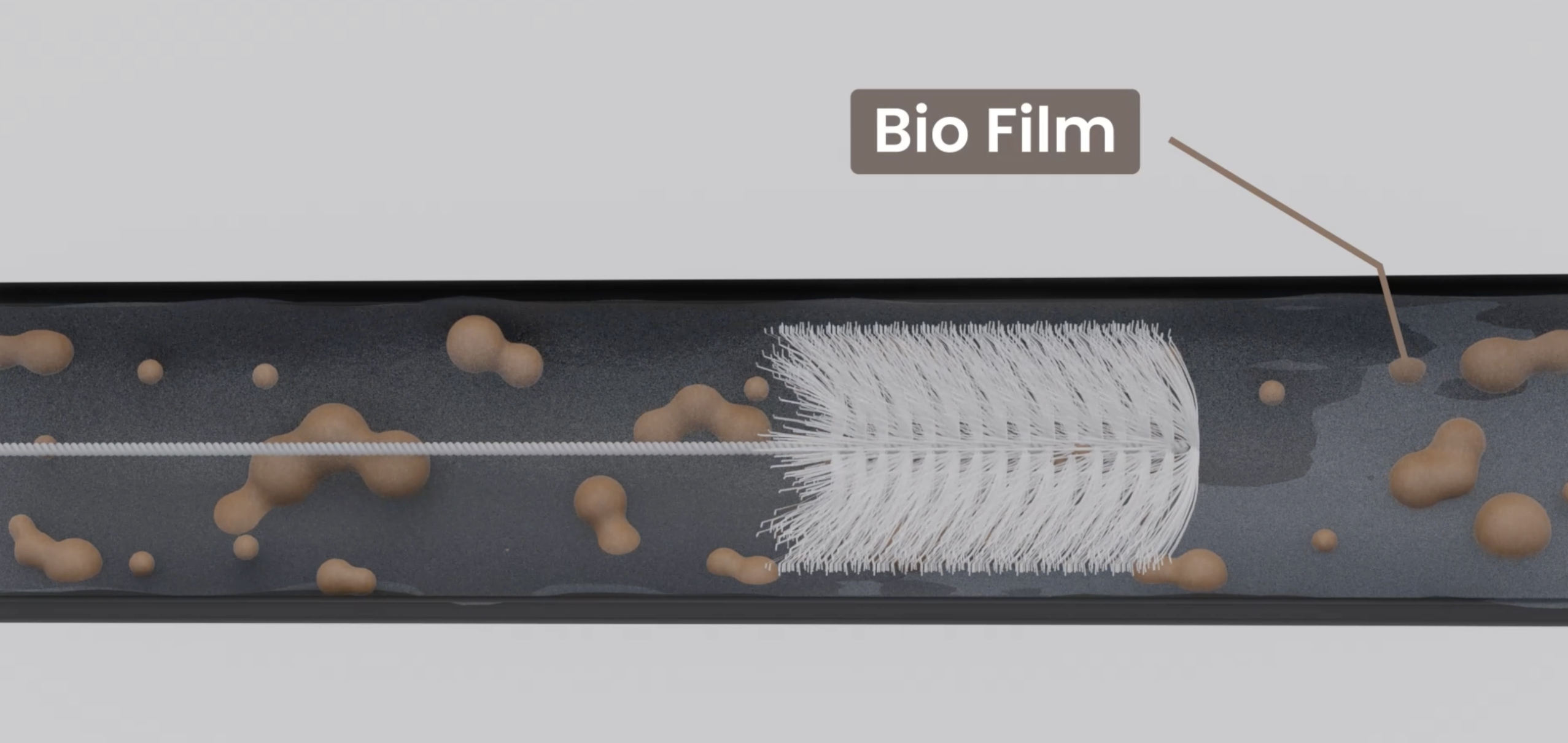
A film you usually can't see
Biofilm is one of those terms that gets used often in reprocessing conversations without always being explained. In simple terms, it's a thin layer of microorganisms that attach to a surface and surround themselves in a self-produced matrix — a kind of protective coating that shields them from things that would otherwise kill or remove them, including disinfectants and even mechanical cleaning. It can form on almost any surface that stays damp and is exposed to microorganisms over time, which includes the internal channels of a reusable medical device.
What makes biofilm tricky isn't that it's invisible, exactly — it's that it doesn't look like the debris people are trained to watch for. It doesn't announce itself the way visible soil does, which means it can be present on a surface that looks clean.
How it actually forms
Biofilm formation follows a fairly predictable pattern, even though the timeline varies by environment:
- Initial attachment — free-floating microorganisms land on a surface and begin to adhere, often in places with reduced flow or contact, like tight bends or narrow channels
- Matrix production — once attached, the organisms start producing a sticky extracellular substance that anchors them more firmly and begins to shield them
- Maturation — the colony grows and develops structure, becoming progressively more resistant to removal as it matures
- Dispersal — portions of the biofilm can break off and spread elsewhere, seeding new colonies on other surfaces
This cycle doesn't require a dramatic lapse in cleaning to get started. Biofilm can begin forming within hours on a surface that isn't cleaned and dried promptly, which is part of why timing matters as much as technique in any reprocessing workflow.
Why it resists standard cleaning and disinfection
Once established, biofilm is substantially harder to deal with than the loose organic debris it's often confused with. Its protective matrix can reduce the effectiveness of chemical disinfectants by limiting how well they penetrate to reach the organisms underneath. And because it adheres tightly to a surface, it often resists exactly the kind of light or inconsistent mechanical contact that fails to fully disrupt it.
This is why infection-control guidance consistently emphasizes thorough mechanical cleaning as a first step, before any disinfection stage: a disinfectant works on the surface it can actually reach, and biofilm is specifically built to reduce what that surface exposes. Understanding this is less about any one product or technique and more about recognizing that biofilm behaves differently from ordinary soil — and that difference is exactly why the cleaning step in any reprocessing protocol deserves the attention it gets.